Tuesday, May 23, 2006

Aunt Mari's 90th Birthday surprise


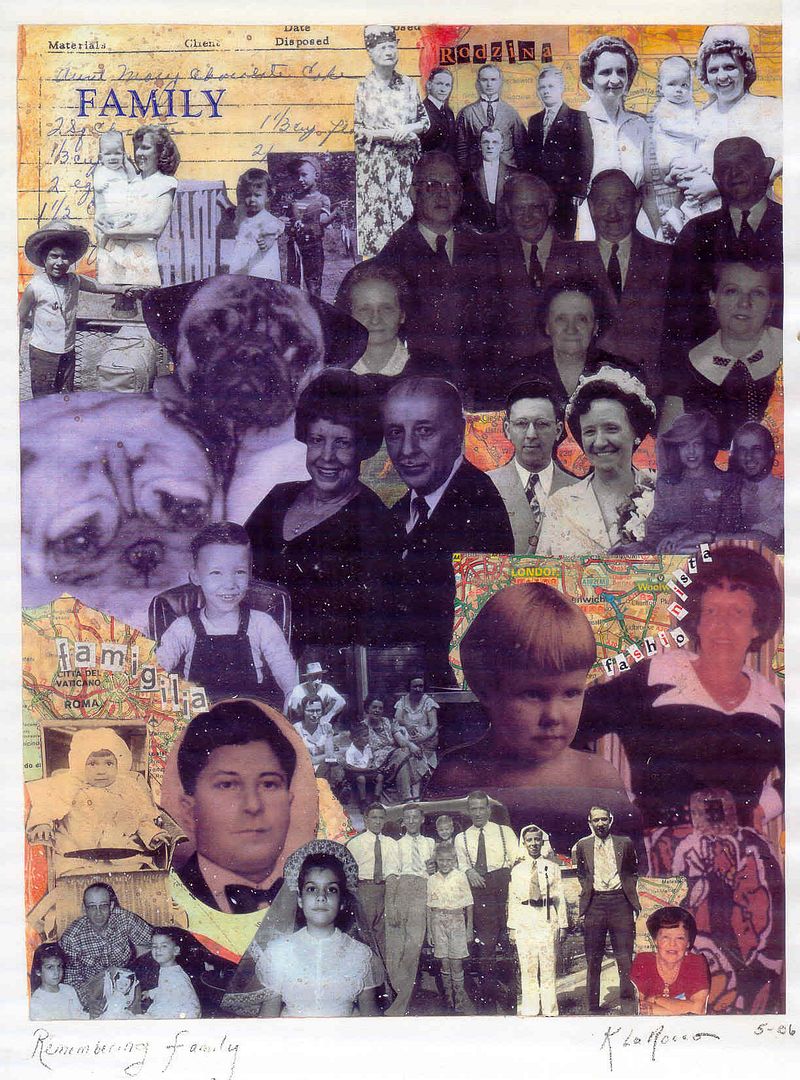
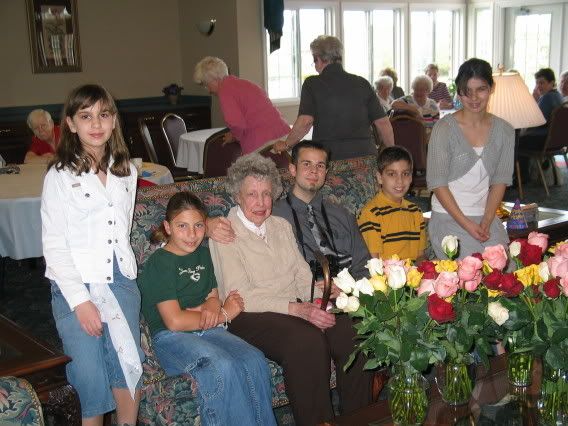
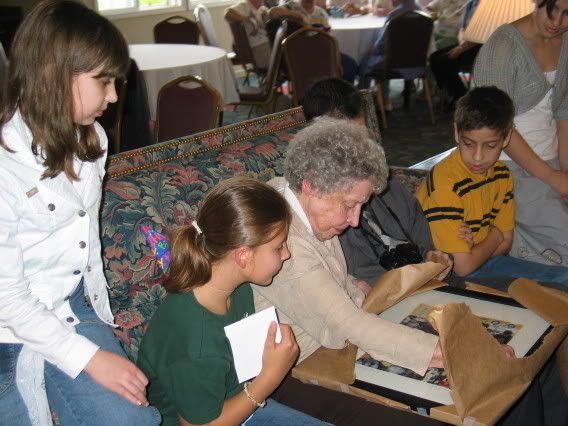
My dear, sweet Aunt Mari turned 90 this past weekend. I was lucky enough to attend. My husband, three children, greyhound, and I piled into our van, drove 3 hours north to Appleton, WI, and along with several other out of state cousins, surprised the he_ _ out of her. Mari's three children planned a lovely party with many of her friends from the retirement community that she lives in, friends from the suburb outside of Milwaukee where she used to live, and her nieces and nephews (that would be me for one). The look on her face when my family and I entered the room was well, priceless! She cried and laughed at the same time. So did I. In this first picture, Aunt Mari is in the middle and her two grandchildren are on either side. The other three are mine. The children presented her with 90 roses. And then I presented her with my collage (the second picture). I can't tell you how much she loved it. There was a scrap book of sorts with many of the same photos in it, along with displays boards, but the collage stood out. Many were amazed at the construction of the work and others wanted to know the symbolism for some of the papers that were used. I am so glad I attempted this and was so pleased with the outcome.

K

Thursday, May 18, 2006

Remembering Family


It is finished! Last night at about 10:00 CST, I put the finishing touches on my Aunt Mari's collage. This was a new process for me. I used Jonathan Talbot's methodologies, but I still needed to work some things out for myself as I put the piece together. Since I most recently have journeyed from a rubber stamp world into mixed media and collage, I felt at first that this was like putting a scrapbook page together. Boy was I wrong. The process began with careful scanning and manipulation (with a crappy photo editor) of more photos than I care to think about. Then I hunted for old maps, recipes and other found papers. After about a week of gathering the material, I was off to the copy center to make color copies. More decisions at the copy center were made (do I want more yellow in the copy etc). Finally I had all the material assembled with the exception of just a few alphabet letters.

On Monday of this past week, I coated everything I had with acrylic medium (as per Jonathan's method). I coated way to much but that is OK because I can use the left over material in other works. While that was drying (both sides of the copies had to be coated), I prepared my water color paper. I used 300 lb arches natural (really yummy stuff). The final size of the paper was 16 by 20 which I then masked off to 11 by 14. The background was added to the substrate (an old dress pattern) and some acrylic paint "splashed" on. Then that surface was coated with acrylic medium. This entire process (with drying time) took about 24 hours.

On Tuesday I began to cut out and arrange the photos and papers. This was an ardent and almost nerve racking experience. There was so much material and I had this idea going that just was not translating to the substrate! I knew I had to have most of the work finished by Tuesday because of my time schedule. After arranging, rearranging, and arranging again, I had something that was pleasing to my eye. I did not want to alter the photos too much (as in a David Hockney look) because my Aunt is after all 90, and I don't think she would have recognized or understood that type of approach. I did have one dilemma though. I really like to integrate my background, especially when I am using a variety of different items. How was I going to do that and keep the arrangement I had in front of me. I had some of the photos tucked behind background elements, in the center of background elements etc...and I did not want the photos integrated into the work. So I settled for a happy medium (no pun intended). I made a detailed drawing of where all the pieces were supposed to be on the substrate and then assembled the collage in sections so I could integrate, at least partially, some of the background. It worked fairly well and although the background papers are not fully integrated, I am pleased with the outcome. A few minor additions were made, the piece was sealed and varnished, titled, and there you have it! A srapbook page? I think not, but you tell me...is it art or craft?

So today is Thursday and I am off to frame the work. Saturday is the big surprize party. I hope she likes it!

Friday, May 12, 2006

Aunt Mari


I have been frantically trying to pull together the material I will need for my Aunt's birthday present. She turns 90 this Saturday! My family and I are heading up to Appleton, WI to celebrate with her. It will be a huge surprise because she has not seen out children in maybe 10 years. So, my cousin, her oldest son, has sent me files of pictures of her and my uncle and other cousins. And the files sat for two weeks. Why? For those of you who have school age children know that the school year is fast coming to a close. I have been swamped with my children's school projects (I hate this time of year) and have not been able to do any art. Today I was able to get to Staples to make some color copies of the materials. Now I have one week to finish.

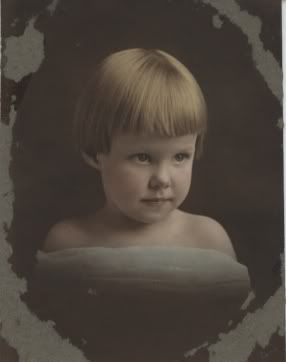
Here is a sweet picture of my Aunt Mari when she was maybe 2. I will be using this one for sure. If nothing else, this project will be a real walk down memory lane. I found an old Newsweek from 1946! Will be using some of that in the collage! I also found my Dad's Boy Scouts membership card from the 1930s. My Uncle (Mari's husband) and my Father were brothers (both deceased). I also found a recipe from my Aunt Mari that my Mom used for years and years. We called it "Aunt Mari's chocolate cake." My Aunt Mari is the last of my aunts. My parents, and my Dad's two brothers, are gone. So this project is very near and dear to me. My Aunt does not even know that we are coming and the gift, I hope, will be icing on the cake.

K

Wednesday, May 03, 2006

loca mesa verde


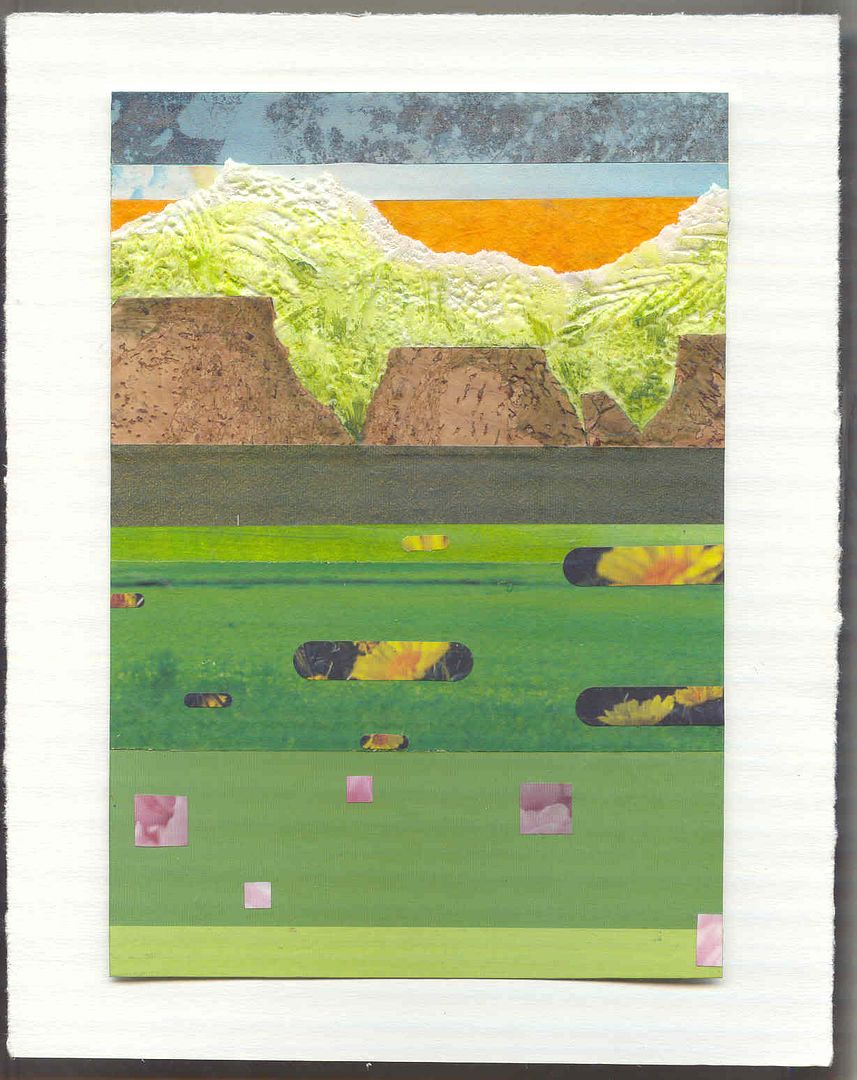
I finished my first challenge for the Midwest Collage Society. The Spring challenge was posted a while back on the Yahoo list. We were challenged to come up with a spring abstract landscape. I thought it might be fun to step out of my comfort zone and I think for a first try, it turned out OK. My inspiration for the the piece is spring in New Mexico. We have traveled to New Mexico many times over the years because my in-laws live in Santa Fe. I think spring is my favorite my season there. It is so alive and fresh. Green is a rare commodity in many areas of New Mexico but in the spring, near Santa Fe, the mesas come to life. And there you have it.

The work is done on watercolor paper, 140lb. A variety of found papers were used, and acrylic paints. I did this collage using Jonathan Talbot's method. I plan on mounting the work to an 8 by 10 piece of watercolor paper. The finished size will be 8 by 10.

Now I have to get to business on my Aunt's collage...Have to finish before the 20th of May.

K

Thursday, April 27, 2006

Jack of All Trades- A Finished Work.


I have three pieces I would like to start and finish before the 20th of May. Now that I have a space cleaned off on my table in my studio, I can finally get down to "business." I need to do something "artsy," as my cousin says, for my Aunt Mari's 90th birthday. OK so no problem right, HA. I decided to do a collage work ,about 11 by 14 in size, of family photos over three generations, from not only her immediate family, but mine, and another cousin's as well. So this is the work that absolutely needs to get done by the 20th of May and I have not even started! I did get a commissioned work done and although it is a minor piece (I had to work with this of photo of Jack), I am pleased with it. The third piece is for a challenge with the Midwest Collage Society.

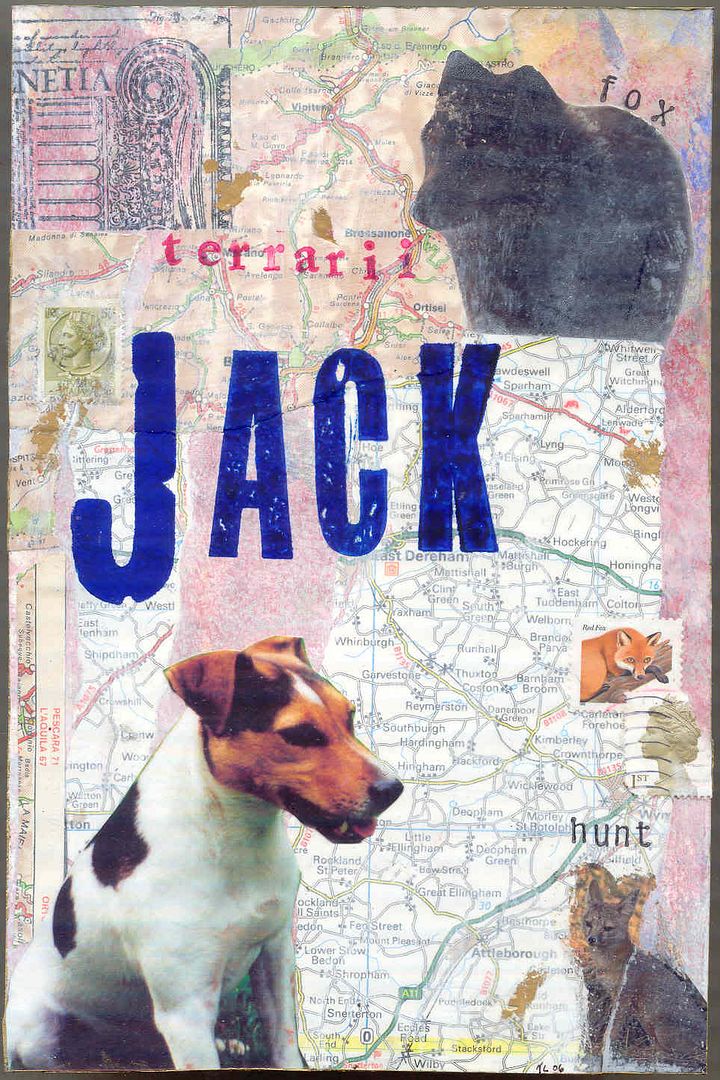
This commissioned work is called Jack of all Trades and is a mixed media piece using Jonathan Talbot's methods. It is interesting how this piece came about. I was at a Dog Workshop at our local college. We listened to topics on holistic approaches to dog care, dietary concerns, animal communication etc... I had a small notebook ( the kind used to take notes in) and I had altered the front cover with a collage. The subject matter was greyhounds. Everyone who knows me is aware of my passion for the breed and that I have rescued two, soon to add a third. A friend that owns a locals pet store catering to holistic, organic, natural products, wanted one as well , but her breed is the Jack Russell Terrier. She gave me a picture of her departed "Jack." I did not know anything about the breed, so I researched it some and this is what I came up with. The work is done on 140 lb watercolor paper and is approximately 6 1/2 by 9 1/2. I could not bring myself to mount the work on a notebook so I copied the work and I will put that copy on the cover of the notebook and give her the original. I hope she likes it.

I have the pieces laid out for the collage challenge and hopefully I will get some time this weekend to assemble it. The challenge called for a spring abstract landscape in either a 4 by 6 or 8 by 10 format. I have already broken the rules...no big surprise, because I think the finished piece will be somewhere in-between those two dimensions.

k

Tuesday, April 25, 2006

Of Picasso


Today is a dreary one here in Northern Illinois. I am trying to clean of space in my studio so I can begins to create once again. I have three works in mind for various commitments. Hopefully I will be able to gather materials for one of them today.

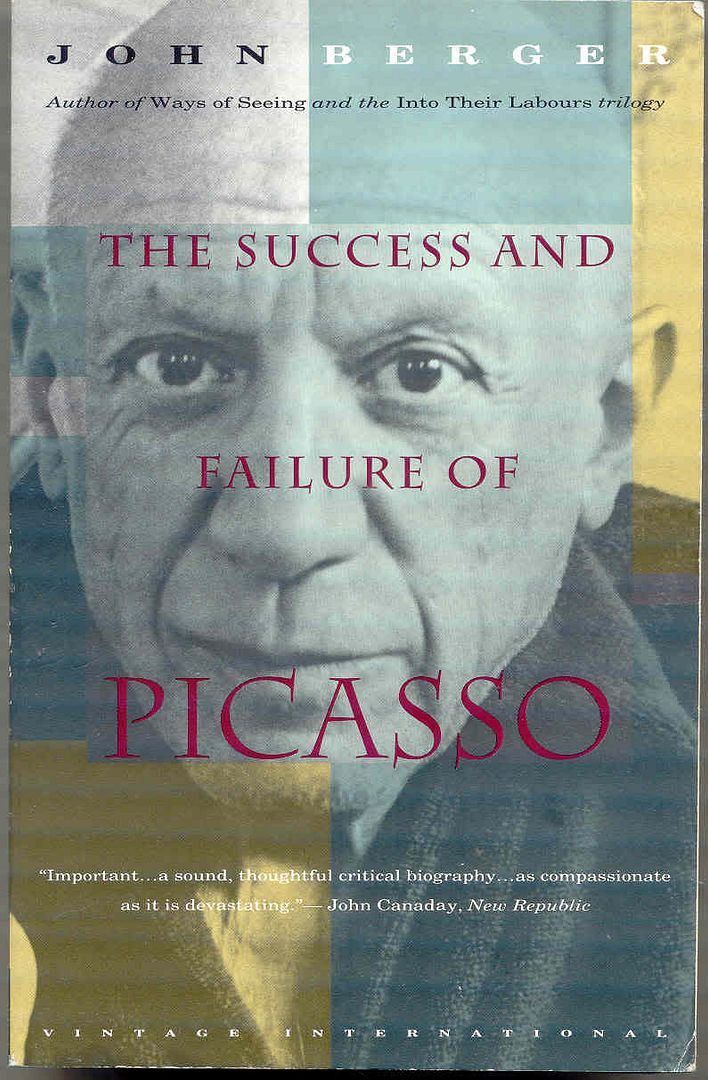
On Berger's book, The Success and Failure of Picasso, this was the first biography on an artist that I have ever read. Jonathan Talbot recommended it and so I purchased it on Amazon. Berger is an excellent writer and he drew me into Picasso's life with the first sentence of the book. I really did not have any strong opinions about Picasso one way or another prior to this book. And this was largely because of my lack of knowledge about the man and artist. I can say, however, that I have always been an admirer of his work because of the great emotions that stirred within every time I viewed any of them. Berger's book taught me a great deal about the man and his art! Picasso's environment shaped him and so much of his art reflects troubled emotions. I remember the reaction I had when I viewed Guernica while in Madrid (pictures in a book do not due the work justice). My husband and the couple we were with, left me alone...I wept. I am not sure the guards knew what to make of me but I wept and wept...Such passion and sadness.....

I think I have always wanted to learn more about Picasso but never took the initiative. I was intimidated by the material available to research...He always seemed so, well, so out of reach, so hard to understand or comprehend... so larger than life...Berger changed that for me! He did a super job of laying a foundation for his discussion about the artist, such that even a complete art history virgin, such as myself, could follow where he was leading. I often felt guilty for not loving ALL of Picasso's art because I could not put my arms around all of it. Many pieces disturbed me or I thought they were not that good or not befitting a genius. The guilt was there because I knew he was a genius and so many critics find no fault with his work. Well now I understand why I feel that way. Berger's work is a must read. It helps to dispell some of the myths surrounding the man and his art.

Sunday, April 23, 2006

The End of Jonathan's Reply


Today I have a little more time. My 11 year old son had a friend over yesterday to celebrate his birthday and well we were hoping again as usual. I had no time for profound thoughts (LOL). So hopefully today I will finish Jonathan Talbot's reply to the challenge he gave me.

This collage was also done in Jonathan's workshop at the beginning of April. This one used his methods which are described in his book "Collage, A New Approach." If you are interested in a copy you can purchase one via his website or attend a workshop and get one as part of the class. I often find myself making political and moral statements through my work. I doubt this piece will ever sell because of the nature of the it. I did need to make this statement and I think it had been brewing inside me for some time. For whatever reasons, it just spilled out of me at this workshop. I call the piece "Choices."

KL: "Your paintings and your body of work makes your statement, be it personal, social, political, or philosophical as my research and publications make mine. Am I onto something here?"

JT: "What I think you are moving toward is the realization that YOUR visual artwork will make your statement in the future just as your research and publications (and professional relationships) did in the past... and professional relationships will be important in the artb world as well."

KL: "No wonder I am in the process of exploring my own creative expression.

JT: "No, there is no surprise in it... You are, because of your experience set, particularly well equipped for this explorative process."

KL: "As for more concrete relations between the visual arts and microbiology...here is one microbiologist's perspective....."

JT :" I enjoyed you making a painters palette out of Eosin, malachite green, carmine, gentian violet, fuschin, and methylene blue. Do you know that during the renaissance most artists manufactured their own paints (they did not, however, always grind the pigments as there were others who did that... but the artists tended to buy the pigments as powders)."

KL: " Clusters of grapes, spiderous shapes, four leaf clovers, worms, chains, corkscrews, and threads ... a variety of colonial morphologies [such] as cavernous, volcano like, mesas and mountain ridges, milky ponds, slick ice patches, snowflakes, and wispy cotton candy. I once remember thinking that I was looking at a southwest landscape. The petri dish contained rich hues of sepia, burnt sienna, raw umber and colonies took on the shape of giant mesas."

JT: " The basic shapes of microbiology are not so different, it would appear, from the plane, cube, cone, and cylinder of the first year composition class... "

KL: " Mold and filamentous type organisms offer perhaps the greatest arrays of color and shapes that I have ever seen. These organisms are often highly pigmented and beautiful shades of greens, blues, yellow, reds, and browns can be observed. The pigments are rich and often are secreted into the growth medium making for an even more spectacular show. The color are sometimes surreal, fluorescent, iridescent... and always spectacular. Colony morphology is as varied as the color and can be described as great craters (like the moon craters), cauliflower heads, fluffy cotton balls, and waves (like the ocean)."

JT:" This passage sounds like a review in Art News!"

KL: " Finally, the way I approached my research should serve me well as I explore the visual arts. Experiments were planned based upon current theories, very carefully, and methodically. It was however, with a bit of serendipity and a I don't give a damn what others think attitude (of course when things weren't going well), that the most satisfactory results were obtained. "

JT: " Well said.."

KL: "Although I have no formal training in the arts... that will not hinder my process but rather challenge me to go forward. "

JT: " Since you have already acquired one formal disicipline (microbiology) and became (I quote from your message) "a sought after trainer because of [your] skills" you now have what you need to acquire formal knowledge in a new disicpline (plastic or visual arts). The knowledge is there, the trainer is there (you), the student is there (you), colleagues are there (artists everywhere, those living and those who have gone before, leaving their work behind), mentors are there (you will find them)."

KL:" In closing, I don't know if this piece is what you were looking for but it is what I was looking for. For me this has indeed been a revelation, a closure and a new beginning all in one!

JT: "Of course what I was looking for had more to do with process than product. But as I understand the process by which you put the "dissertation" together, and as I read the results of that process, there is a sense of satisfaction and I am grateful to you for it."

KL: " My work is for me now and may always be [a revelation, a closure and a new beginning all in one!] "

JT: " This single sentence is enough to form a firm foundation for a lifetime of work... May I quote you?"

Cordially, Jonathan

And so there you have it. Jonathan is a remarkable artist, capable of greatness. But more wondrous to me is what a remarkable human being he is. He read my little dissertation and put thought into a response, one that he knew instinctively, would be very, very important to me. Jonathan, if you are reading this, I thank you again for taking the time to indulge me. You words have made, and still continue to make, a difference in how I approach my art and my life.

K

Friday, April 21, 2006

More about the visual arts and microbiology.


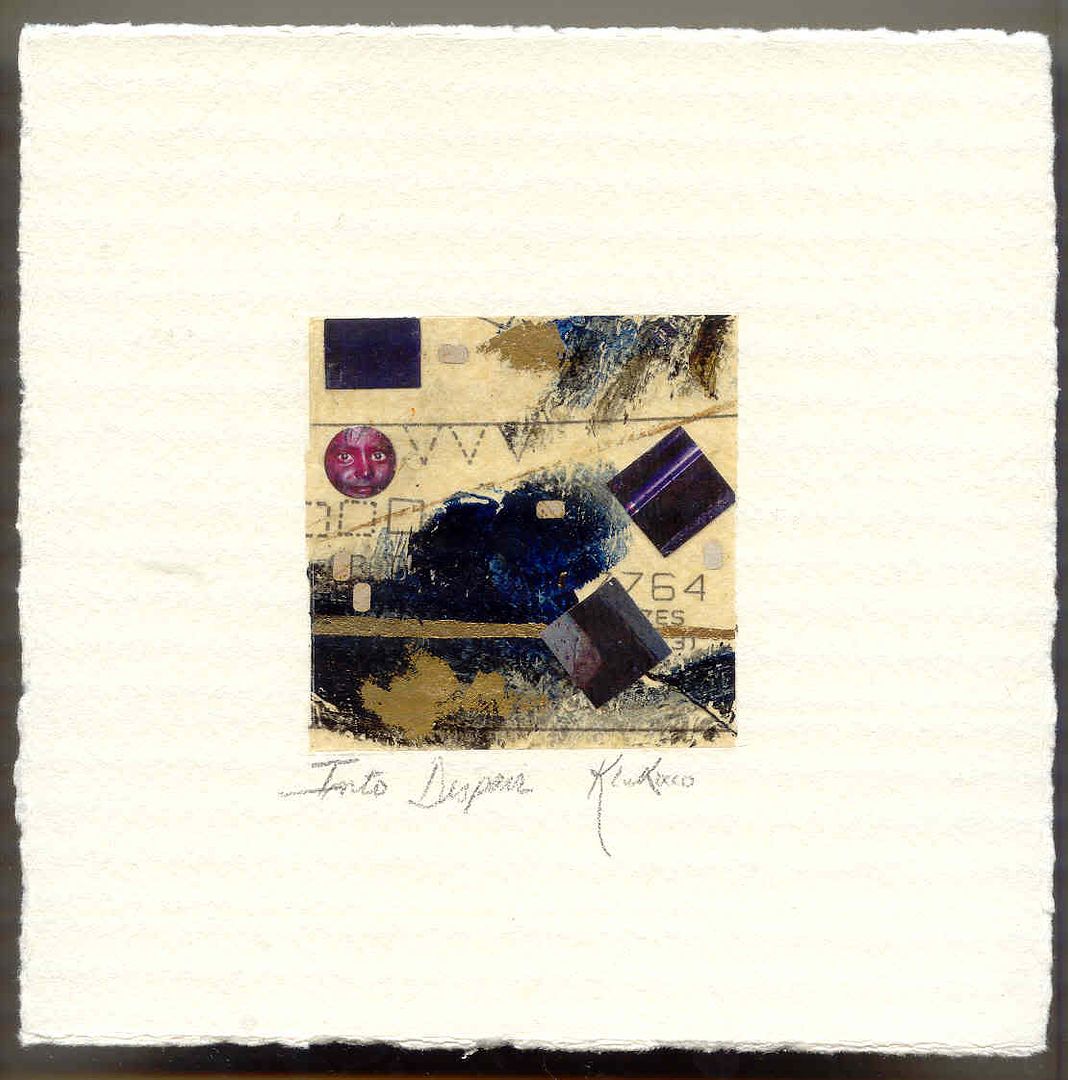
Today I came home from work with one of my splitting headaches. I am usually incapacitated when this happens. So my entry for today will reflect just a bit more of Jonathan Talbot's response to me. In addition, this second piece was done at his workshop (the beginning of April). It is called "Into Despair." and is a reflection of how I was feeling that day. Jonathan had crammed so much into his workshop and I wished it would not end. I felt there was so much more to learn and experience.... This is a mixed media piece done on 300 lb watercolor paper. It is one of my favorites.

KL: " ...I retired after 20 years in my field to stay at home with my young children. They are now 11 and 9 (the twins). During my time in the field I developed a keen sense of observation (almost legendary at Abbott Labs)."

JT: " This will stand you in good stead in the plastic arts..."


KL: "became a sought after trainer because of those skills,"

JT: "This, too, will be useful as you redirect your energies to a new discipline..."

KL: "published numerous research articles including a chapter for a book, received prestigious awards for my work, and learned to say "WHY NOT?" or "WHAT IF" when others said "NO WAY."

JT: "Your ability to articulate your thoughts and feelings will enable you to engage in dialogues with yourself and with others about what you are doing art-wise and your art will be richer because of it..."

KL: "Intuition was as important as my book knowledge and so I would often find those "problematic" organisms sitting in my lab courtesy of my molecular geneticist colleagues."

JT: "When one stands upon a solid foundation of classical training and allows one's intuition "free play" the possibilities are almost limitless."

KL: " Some of those qualities mentioned above surely must be shared by those in the arts. Good observation skills, a rebellious nature, sense of adventure, childlike wonder, experimentation skills, and tenacity may be seen and felt by the observer."

JT:" Of course you are right... Just do some reading about artists (rather than art) and you will find confirmation of this. For a start I suggest John Berger's "The Success and Failure of Picasso," a short but pithy work will I believe you will enjoy. "

And here I will end for today. More to come. Oh, and I did read the Berger book. I will review that later as well. It is a must read, one that will open your eyes to Picasso.

Wednesday, April 19, 2006

A response from Jonathan


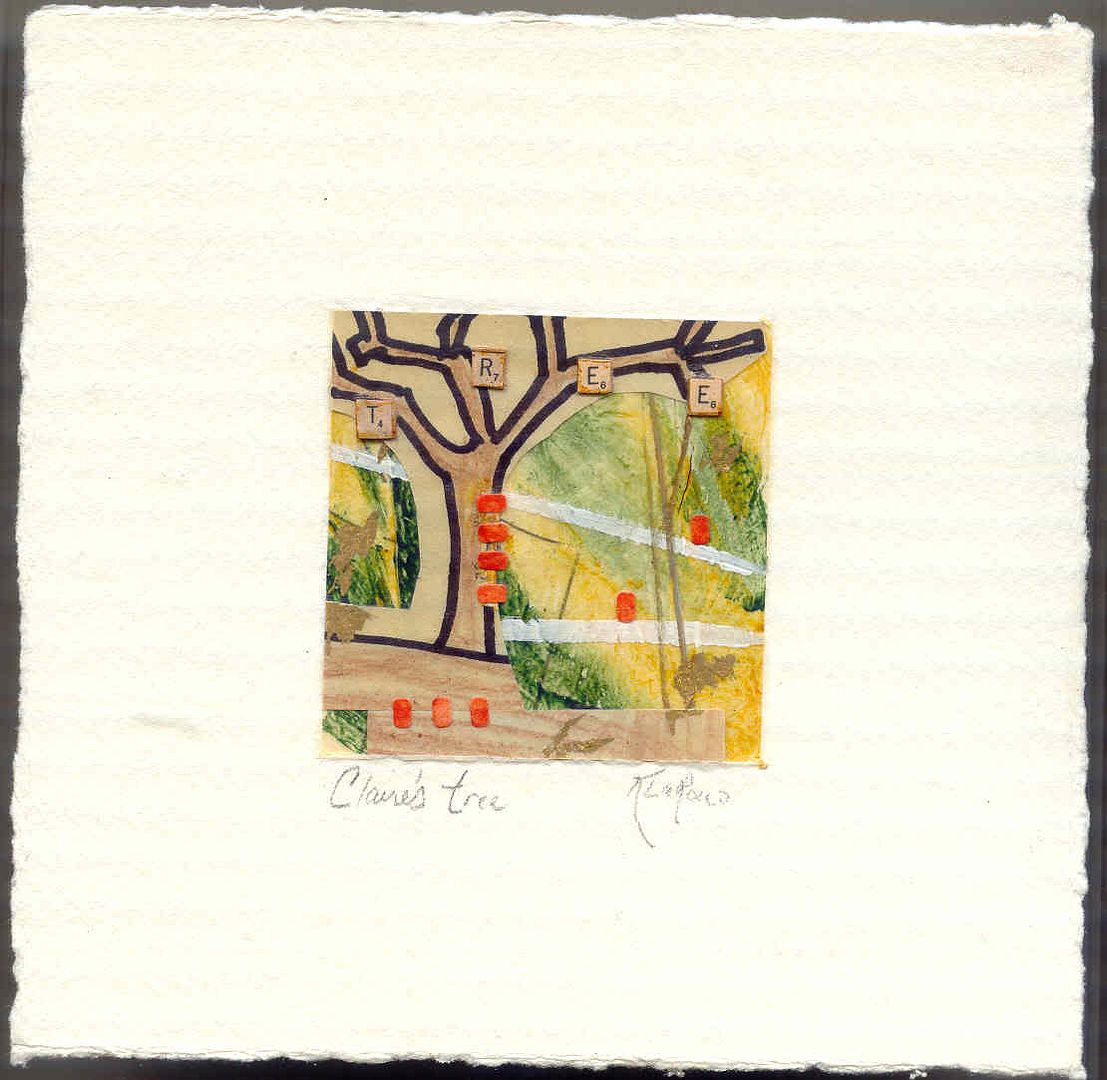
This is one of the small pieces that I did at Jonathan's Collage Workshop at The Art Center in Highland Park, IL. (the beginning of April.) I really loved this free style way of creating a piece of art. It is a wonderful way to work on several pieces at once or to work on a series of pieces. The finished size of the work is 7 by 7 inches and is a mixed media piece on 300 lb watercolor paper entitled "Claire's Tree." Below I have outlined a portion of the artist's reply to my comparison of microbiology and the visual arts.

After sending Jonathan my response to his first challenge (see the April 14th entry in this blog). I really don't know what I expected. I will say that I received a tremendous amount of gratification in actually doing the challenge and in realizing that I could use the right side of my brain. I sent that Email and then left for the day. While I was gone, Jonathan called me, leaving a message stating that he wanted to reply to my visual arts and microbiology comparison. I was so stunned that I would be taken seriously by such a well-known and very busy artist. So here are excerpts from his Email. I have annotated the text with JT (for Jonathan Talbot) and KL (for myself)

JT: "Before I begin my "detailed" reply to your "dissertation" please know that I was delighted and impressed by the way you responded to the challenge I so presumptuously placed before you. Having read your words, I believe that you realized that this exercise would be a productive one for you and that I, too, might learn something in the process...Now I will move forward in "Email fashion," responding to some of the points you made and hopefully interspersing a few of my own..."

KL: "..As I write this, I feel a sense of wonder... I begin to understand why creating has always been a part of me, has always been lying just underneath the surface waiting to be recognized by my conscious self. "

JT: "Thank you for sharing that with me..."

KL: "[This dissertation] is written so that you might understand where I came from as a scientist... "

JT: " Thank you for describing the education of a classically trained microbiologist in such detail. Clearly your training formed an solid foundation for your subsequent creative work. It is like that in painting as well... Most innovators have a solid grounding in, and a respect for, the history of their discipline."

KL: " Don't be fooled...this work is by no means glamorous and is often done behind the scenes. It can be considered repetitive and downright "dowdy."

JT: " I giggled when I read the above... So many folks think painting (being an artist) is glamorous and most experienced artists realize that while there are, at times, euphoric breakthroughs much of what we do is repetitive (just look at the works of a single artist in detail and that will become clear... One does not establish a personal style without repetition). "

KL: " The sexy side of this science, if you will, is the molecular genetic or molecular biological approach... "

JT: " The cutting edge of what is going on is always exciting... and the implications of DNA "engineering" are both exciting, scary, and profound (scary because human beings are so unreliable and often out of touch with their relationship with the rest of the biological world)."

Jonathan continued and so will I, tomorrow.

K

Aubrey's Dream Journal


Another artist that I greatly admire (living artist that is) is Claudine Hellmuth. Her style is clean and her use of texture and color is well, legendary! I belong to her Yahoo group and frequent her blog. I have devoured her books and instructional DVDs and truly enjoy incorporating a variety of textures in my work thanks to these publications. Her instructional style is straight forward and almost easy. She teaches the kind of techniques that I bet most new artists wonder about. You know, when you look at a mixed media piece and say "I wonder how she did that?" Or how about "This looks really complicated and I could never do that!" Wrong...try one of Claudine's books and you will be hooked.

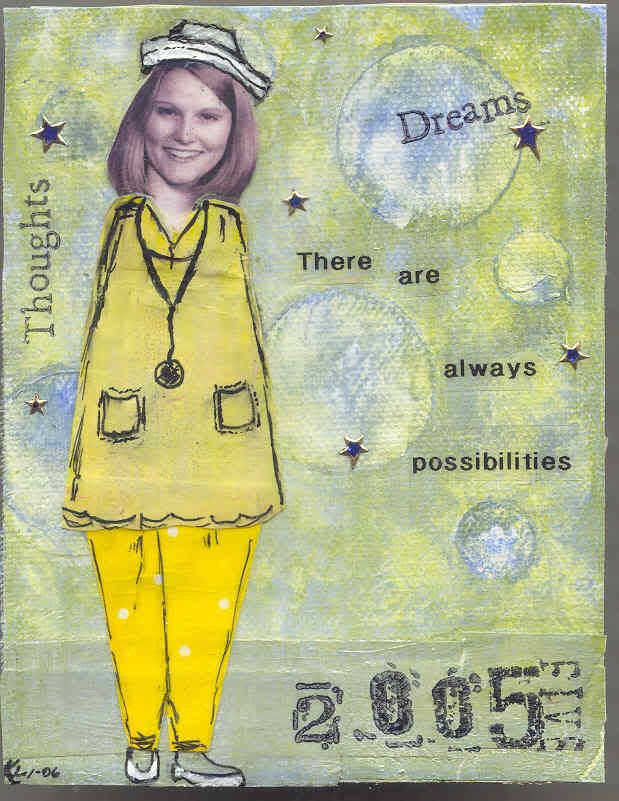
Ok so this piece is actually my third in Claudine's style. I love doing these characters for friends. I have been making dream journals for special presents. This is a journal that everyone should have. One that you can write down your wildest dreams and aspirations throughout the years. It is meant for your eyes and so no one can judge it. Cross off your dreams as your achieve them! Anyway a young woman, who used to be our babysitter, had just graduated from college this winter. This was her gift. What I do is buy a nice looking journal and then I do a painting for that individual. I either affix the finished work to an inside page, or the outside cover. In this work I use several of Claudine's background methods including rinse aid and contact paper.

As an aside note, I have asked Jonathan Talbot for his permission to publish his responses to my challenges. It is a go ahead and I will start to do so soon.

K

Tuesday, April 18, 2006

Of Frida and Birthdays


Yesterday was my twins birthday. They had school off and we spent a fun day shopping and celebrating. Can't believe they are now 11. Needless to say I was very busy most of the day and evening with their celebration. I worked until noon, and then I don't think I sat down until about 10 at night! Too tired to enter a journal page.

Today I have busy work. Thank you cards to make for the twins, to hand out, thank you cards for our Easter celebration, a birthday card for my Father-in-Law and well other assorted household things. No real work on art projects today :(

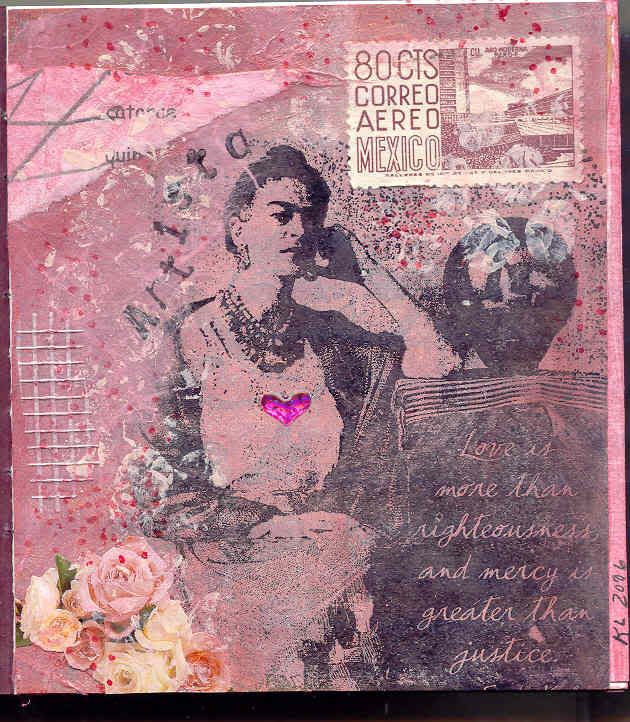
Frida has always been one of my favorite artists and whenever I can, I work on a deco page or two using her art or her image as a theme. Above is a recent one. This is a mixed media collage using inks and acrylics, rubber stamps, found papers and stickers.

K


Sunday, April 16, 2006

Happy Easter


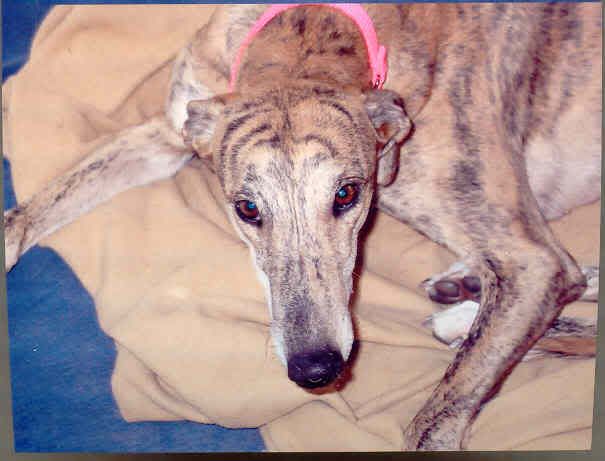
What a nice day. I always love these holidays. We spent the day at my husband's sister and brother-in-law. We took our new greyhound, Mandy (she came home with us Feb 4th of this year). She is a pretty and petite brindle girl. This picture was taken Feb. 5th. Once at our destination, we all had a fun time. My children enjoyed playing with all the dogs (three all together) and the dogs got on famously. The food was fabulous and the family time was priceless. We just let the day unfold for us and did not worry about much else. Little Miss Mandy did try to escape but thank goodness my oldest had the presence of mind to catch her before she realized she was free!

I shared some of my art with my brother-in-law. He is an accomplished sculptor and painter working in mostly oils. I so admire his work and was eager to share some of mine with him. It is always gratifying when an artist asks me how I did a work. Well now it is time to get ready for the work week....

K

Saturday, April 15, 2006

Easter Chocolate


Image hosting by Photobucket
It is Holy Saturday, a day of reflection and anticipation for us Catholics. I am spending the day with my family. A walk with our new greyhound, Mandy, seems very appropriate. In view of the upcoming Easter Celebration, while certainly one of the holiest in the Catholic Church, my children always seem to make it about the chocolate! So yesterday I finished another deco page with a yummy theme in mind.

Decos have been around for sometime but if you want to read about them, I suggest Lisa Vollrath's website: http://www.lisavollrath.com/pages/category/how-to/. She has a wealth of info there about decos and you should find a ton more interesting items as well. I took to doing decos right away because the support or canvas, if you will, is usually small. For me, anyway, it allows me to work out some spatial issues for larger pieces, and the smallness is not so intimidating. Also, the extra added bonus is that when your deco is done, you get to keep some amazing art! I always get inspired when I get to see and touch art done by others!

In the next couple of weeks I want to document some of my email discussions with Jonathan Talbot. Hopefully they will give some insight to those beginning their art journey and provide some interest to those already well into their journey.

k

Friday, April 14, 2006

Tag for travel deco 4-13-06


Image hosting by Photobucket

So here is the tag I finished yesterday for a swap in ArtDecos. It is a mixed media piece using Jonathan Talbot's transfer and collage methods. This is a Yahoo group that I belong too. The art rivals many and I am Proud to be a member of this group. Lisa Vollrath moderates it and she does a great job.

So I promised to post more about me. About two years ago I began a correspondence with Jonathan Talbot. I was exploring his alternative method in collage and wanted a tacking iron. Needing more information I called his home thinking it was a gallery or something and expecting to talk with a sales person. Boy was I naive! I was fortunate enough to talk to the artist himself! Our conversation turned quite long and he gave me a challenge. Below is my rsponse to his challenge and that should be enough to document my beginnings.


"As for your homework assignment, I believe it went something like this: "Write me an email describing the relationship between microbiology and visual arts. OK so as I gave this some thought, I realized this would reveal some basic truths about the science that was so much a part of my life (20 plus years) and the artist within. As I write this, I feel a sense of wonder. By this I mean that sensation which occurs when a child realizes that a firefly light isn't hot but rather cool to the touch. I begin to understand why creating has always been a part of me, has always been lying just underneath the surface waiting to be recognized by my conscious self. Even during my rigorous studies, followed by my scientific career, the process of creative expression was being developed. With this said let us begin this dissertation (I don't mean to scare you here), with some rather boring background information. It is written so that you might understand where I came from as a scientist.

As there are numerous types of doctors such as surgeons, internists, pediatricians, general practitioners to name a few, there are numerous types of microbiologists. Mycologists, taxonomists, clinical, industrial, food, epidemiologists, are just a few. As doctors specialize, so do microbiologists. These scientists have come through the system in a couple of ways; either being educated in a classical approach or in a molecular genetic program. The training I had in college and graduate school was considered classical training. That means we memorized like hell for 4-6 years, every fact about the existence of every known group, genus, and species of organism. Bacteria, mold, viruses were all included. Of course there was more to it than memorization...there were all those laboratory techniques to memorize (ha). We learned how to actually manipulate basic functions of the cell through classical mutagenesis procedures. That was the fun part! We had to understand biochemical pathways for a given type of organism so that we could mess it up and hopefully create a "super bug," so to speak. Depending upon the discipline, the microbiologist could create a new organism that was say less pathogenic than its parent, or that produces a new substance, or more of an antibiotic, etc. Our educational backgrounds were often through the biological sciences with chemistry thrown in for good measure. In advanced work we took more complex science and engineering topics as well as the microbiology specialty.

As a classically trained microbiologist we were taught to rely on our senses including sight, smell and sometimes even touch when it came to an organism's isolation, cultivation, and identification. While book knowledge was certainly a good thing, our intuition was almost revered and this is one reason why microbial isolation and identification is often called an art form. Don't be fooled...this work is by no means glamorous and is often done behind the scenes. It can be considered repetitive and downright "dowdy." Methods used in altering cellular function is often random and can take many months and years to find that needle in the hay stack. These methods are based upon screening thousands and thousands of individual colonies in order to find the culture that exhibits the properties one is hoping for. Alas there seems to be less of us trained in a classical environment these days....The sexy side of this science, if you will, is the molecular genetic or molecular biological approach. These scientists are highly skilled and usually have advanced degrees in biochemistry or biochemical engineering before they enter this type of program. They usually attain a Ph.D. in this area. This is where it is at today! Tinkering with the basic building blocks of life, DNA, offers tremendous possibilities in all areas of microbiology. By sequencing the genome of a human pathogen such as the Aids virus, or the genome of an organism that produces a life saving drug affords major break throughs in therapy and disease prevention or in the manufacture of improved compounds or even new ones. The possibilities seem endless and very promising.

What I have described thus far are two general pathways to a microbiology career. It is not meant to be inclusive or even authoritative. Just know this has been a part of my experience. Molecular genetic techniques were just being developed when I went through grad school in the late 70's and so as I mentioned above, I came through a classical approach in the area of food microbiology. I retired after 20 years in my field to stay at home with my young children. They are now 11 and 9 (the twins). During my time in the field I developed a keen sense of observation (almost legendary at Abbott Labs), became a sought after trainer because of those skills, published numerous research articles including a chapter for a book, received prestigious awards for my work, and learned to say "WHY NOT?" or "WHAT IF" when others said "NO WAY." Intuition was as important as my book knowledge and so I would often find those "problematic" organisms sitting in my lab courtesy of my molecular geneticist colleagues.

Some of those qualities mentioned above surely must be shared by those in the arts. Good observation skills, a rebellious nature, sense of adventure, childlike wonder, experimentation skills, and tenacity may be seen and felt by the observer. Your paintings and your body of work makes your statement, be it personal, social, political, or philosophical as my research and publications make mine. Am I onto something here? No wonder I am in the process of exploring my own creative expression.

As for more concrete relations between the visual arts and microbiology...here is one microbiologists perspective.....Classically trained microbiologists spend an inordinate amount of time looking under the microscope. Our sense of sight becomes honed here if you will. In addition we rely on some other basic tools...the test tube and the petri dish (both vessels used in culturing microorganisms). To a lay person or new scientist, the world beneath the scope is strange and confusing. Organisms associate in such amazing ways but if one looks long enough, patterns and shapes emerge. Using staining materials such as Eosin, malachite green, carmine, gentian violet, fuschin, and methylene blue, the specimen now readied for examination, reveals an explosion of colors that gives way to distinctive shapes, and patterns. Clusters of grapes, spiderous shapes, four leaf clovers, worms, chains, corkscrews, and threads are but a few descriptions that I have either used or heard over the years. Those descriptions help to associate a given group of organisms with what is seen under the scope. These tiny organisms are not so foreign when you describe them in terms of your environment. As an organism grows on a given solid medium (source of food often in a petri dish), a variety of colonial morphologies can be described as cavernous, volcano like, mesas and mountain ridges, milky ponds, slick ice patches, snowflakes, and wispy cotton candy. I once remember thinking that I was looking at a southwest landscape. The petri dish contained rich hues of sepia, burnt sienna, raw umber and colonies took on the shape of giant mesas. Cool huh? Growth in a liquid substrate reveals slimy stringy suspensions (like clear gel tar), or pellicle suspension (like shavings of white crayon) to describe just a few. Mold and filamentous type organisms offer perhaps the greatest arrays of color and shapes that I have ever seen. These organisms are often highly pigmented and beautiful shades of greens, blues, yellow, reds, and browns can be observed. The pigments are rich and often are secreted into the growth medium making for an even more spectacular show. The color are sometimes surreal, fluorescent, iridescent... and always spectacular. Colony morphology is as varied as the color and can be described as great craters (like the moon craters), cauliflower heads, fluffy cotton balls, and waves (like the ocean). Finally, the way I approached my research should serve me well as I explore the visual arts. Experiments were planned based upon current theories, very carefully, and methodically. It was however, with a bit of serendipity and a I don't give a damn what others think attitude (of course when things weren't going well), that the most satisfactory results were obtained. I have always enjoyed the experimental design aspect of my work and this explains why I took those first baby steps into the art realm. My inquisitive nature (crucial for good science), a thirst for knowledge (again right up there on the list), and being aware that failure can be a good thing, a learning experience for sure, are now being used in creating something as small a little card.

So this is the revelation...that microbiologists by their nature and training, posses the tools to enjoy the creative process. Although I have no formal training in the arts (I don't count the workshops I have taken or the few college courses in watercolour), that will not hinder my process but rather challenge me to go forward. In closing, I don't know if this piece is what you were looking for but it is what I was looking for. For me this has indeed been a revelation, a closure and a new beginning all in one! My work is for me now and may always be so...however it is the creative process that is being fed and the joy of discovering something new with each step that I take.

Sincerely,Kathy


PS: I love a good challenge and thank you for indulging me!".

And there you have it. Jonathan has been an inspiration to me for some time. Thanks to his poking and prodding, I have discovered more about myself and capabilities than I would have on my own. I was lucky enough to take one of his workshops and will write more about that later!

K

Thursday, April 13, 2006

Coming to terms with HTML

Ok so this is my second day blogging. I now know why I did not start blogging long before. I will be on the computer many hours trying to get this to look the way I want it. I have admired the blogs of numerous mixed media artists and have read daily entries for years now.... I am going to have to try to limit my time here or I won't get much else done.

I need to get some art done today and I also want to figure out how to put photos on my blog. It is somewhat confusing. Those are my goals today. Next time I post I will add a very interesting insight into who I am or maybe who I am becoming.


K

Wednesday, April 12, 2006

Catching up with the Technology

Well here I am, trying a blog for the first time! I decided to blog in order to document my feelings as I continue a right side of the brain journey. So much of my life has been left sided. More about me later. Suffice to say I have taken the first step!.

Kathy L